In later years, my mother occasionally spoke of the acute suffering endured by many of the Irish. She apparently heard the stories from her father and grandparents. Although she did not address specific horrors of the famine, she spoke of it with emotion.
William
and Catherine eventually found their way to Middletown, Ohio where
they were married on March 10th, 1857. The marriage is recorded
in the archives of Butler County, Ohio. Shortly after their wedding, they moved
to Brimfield, Illinois, near Peoria. It was here that nine children were
born. In 1868, the Kellys moved to a farm near Gardner in Johnson County,
Kansas, where they
had six additional children.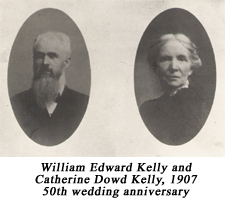
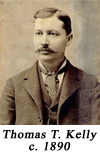
In the family histories that have been provided to us, Thomas T. Kelly is shown as the fourth of fifteen children born to William and Catherine, and this would place his birth date in 1861 between John D. Kelly (1860) and Edward E. Kelly (1863). Tom’s wife, Katherine, held a surprise dinner to celebrate Tom’s 30th birthday in 1891.3 At the time of his death, however, Katherine seemed to believe that his birth date was in 1864. She may well have been confused about this due to the shock and untimely nature of his death. The death certificate from the City of St. Louis reflects this confusion and the erroneous date was thus recorded in the local newspapers at the time of his death, and etched forever on his grave stone in Holy Cross Cemetery just outside of Paola, Kansas. The archives of St. Joseph Catholic Church in Brimfield, Illinois, reflect that Thomas Kelly was born on December 8th, 1861 and baptized on February 16th or 17th, 1862 and I feel that resolves any discrepancy regarding his date of birth. We are advised that the original entry of this baptismal record is in Latin, very faded and, unfortunately, does not indicate any middle name, so we are left with another mystery as to what the middle initial “T” stands for, if in fact it stands for anything.
 We
have little information about Tom’s early years, or about his education,
in particular. We know that he that he was interested in education, and
we learn from the local newspapers that he
taught school for several years from 1884 through 1887 in District 34,
Maple Grove, near Stanton in Miami County, Kansas, and on December 14th,
1888, opened a writing school in Maple Grove schoolhouse, on Friday evenings.
We
have little information about Tom’s early years, or about his education,
in particular. We know that he that he was interested in education, and
we learn from the local newspapers that he
taught school for several years from 1884 through 1887 in District 34,
Maple Grove, near Stanton in Miami County, Kansas, and on December 14th,
1888, opened a writing school in Maple Grove schoolhouse, on Friday evenings.
My mother, Hazel Kelly, was always grateful for the education her parents gave her, and truly adored her father, but, in later years, when told that he had been a school teacher, mused that she could not understand how he could have been much of a teacher inasmuch as he “could not spell for applesauce.” However, a review of his writing, later in his career, particularly when defending his integrity, revealed that he was capable of eloquence, despite some spelling lapses. Public schools prior to the 20th century were often referred to as “common schools” to distinguish them from private schools that were attended by children from more affluent families. Teachers in the common schools, particularly in rural areas, were often not required to have professional training.4
In 1884 Tom bought a farm in Stanton Township in Miami County. On December 29th, 1885, he married Katherine Graham in Wamego, Kansas. The marriage is recorded in the archives of St. Bernard Catholic Church in Wamego. (The translation from the Latin is at the bottom of the page, and was graciously provided by my friend Nicholas F. Kuntz.) The church secretary explained that the records from that time are maintained at St. Joseph’s Church in Flush, Kansas. In the 1880s, St. Joseph’s was the area’s main parish while St. Bernard was an Indian mission. As populations shifted over time, the positions of the two churches were reversed, with St. Bernard taking the more prominent position. It is worth noting here that the name of “Katherine” has also been passed on through several generations, just as her husband’s name has been. Following the marriage the couple took up residence at Tom’s farm where they lived for four years.
3 The Western Spirit, Paola, Kansas, December 11, 1891
4 Carl F. Kaestle, Pillars of the Republic: Common Schools and American Society, 1780-1860, pp. 20, 131-132, 219

